Saturday, July 16, 2011

War Remnants Museum


I was a junior in high school the first time I visited the United States National Holocaust Memorial Museum. Since then, I’ve visited the museum many times; as it is currently part of the Washington, D.C. trip I take with my 8th graders. Each time I visit, I am shocked by the reality of what the Nazis did, and how many different people stood by and let it happen. The message, however, is what “they” did to “them,” allowing me to feel deeply, but, at the same time, not personally implicated.

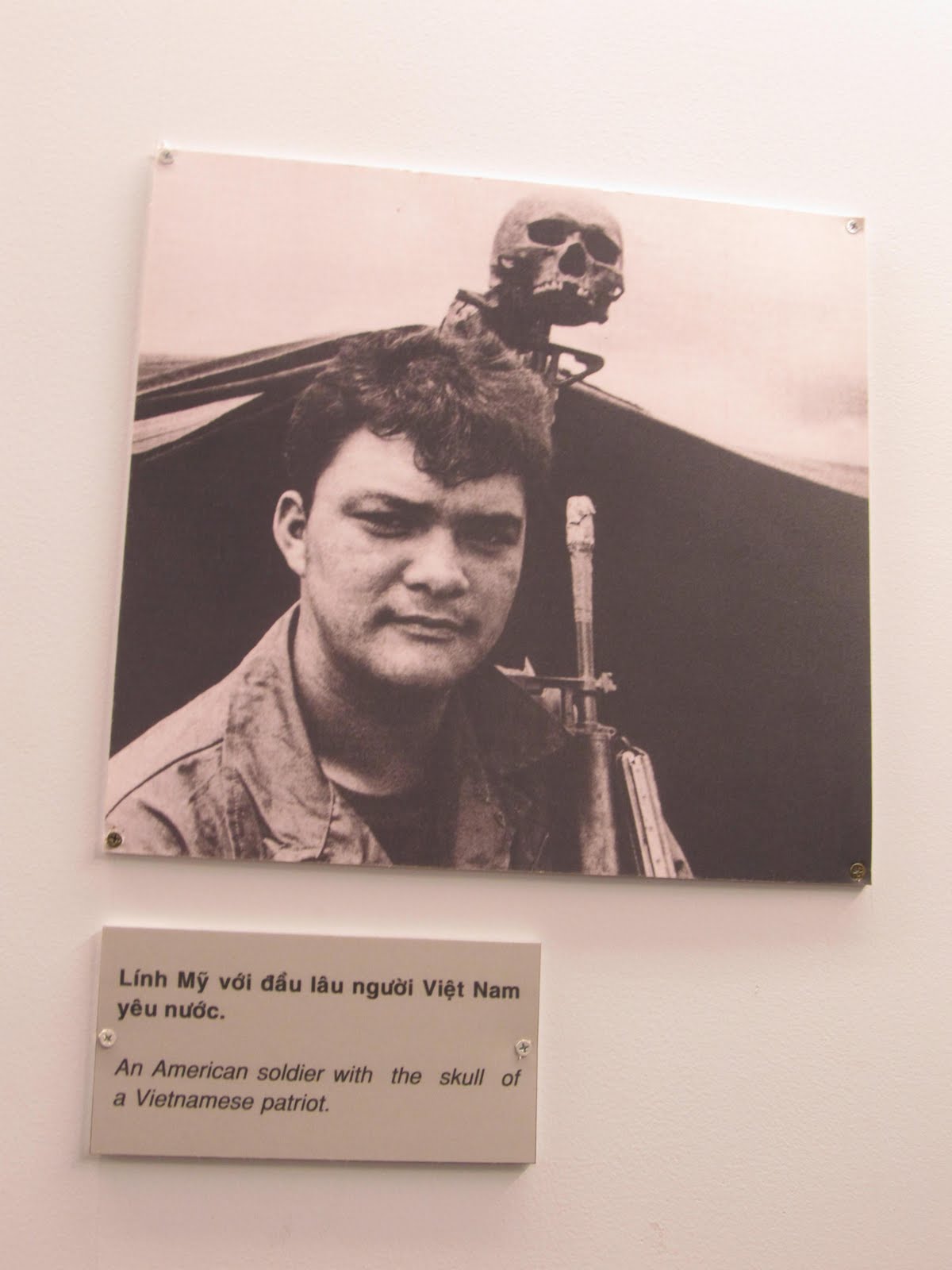
The War Remnants Museum in Ho Chi Minh City is similar to the Holocaust Museum. The exhibits would have been powerful enough to leave me speechless, even if the “aggressor” had not been the United States. The additional impact of seeing images of American soldiers performing incredibly savage acts of brutality, however, was almost more than my physical body could withstand, and I almost had to run to the bathroom. One exhibit was filled with images of tortured Vietnamese people, including woman and children. Another exhibit focused on the impact, long and short term, of Agent Orange, which continues to negatively impact the lives of more than three million Vietnamese people in the form of birth defects, cancers and other disorders.

The reality of any single person being forced to withstanding the type of physical pain and psychological trauma I saw demonstrated in many pictures in the museum instantly made me hate war with even more intensity than I knew I had inside. It also made me scream inside, knowing that, in the eyes of the Vietnamese, we did this to them. And, as an American, I was part of the we. The museum also reaffirmed my belief that the American government should do more to admit responsibility for the problems caused by the dioxin in Agent Orange, which also continues to harm the lives of U.S. Veterans. We cannot change the past; the fact that our government dropped a horrible chemical onto the forests and fields with the goal of destroying foliage, but resulting in deplorable effects. We can, however, change how we respond to the continued impacts of this decision in the future…and I do not think that is too much to ask of my country.

Friday, July 15, 2011

America and Vietnam relations…different than anticipated

This posting was actually written on 7 July 2011. For a variety of reasons, it was not posted while in Vietnam.

When I told people I was visiting Vietnam this summer, maybe people immediately brought up the war. In fact, I believe many Americans have not fully been able to move past the Vietnam War. For my parent’s generation the war seems to be definitive in the development personal identities. The treatment of boys returning from a fight they were drafted to fight is also a controversial topic, as many came home broken. Americans saw Buddhist monks burning themselves alive in protest on tv, and four students were killed during a protest in Ohio.

In school I learned a great deal about WWII, as a fight worth fighting. The Vietnam War, however, was not touched upon in the classroom. I don’t think it was because they didn’t think it was important, but rather too personal and divisive from my teachers to process in the neutral way required in a classroom. When I was a junior in high school I visited Washington, D.C. for the first time, and I saw the Vietnam War Wall. I remember being overwhelmed by the letters, flowers, pictures, and poems left by family members for the loved ones listed by name on the massive wall. So many thousands names; names of people killed fighting a war that, in high school, I still didn’t understand.

In collage, I learned more about the events leading to the Vietnam War. The Vietnamese have been fighting off invaders and colonizer for about 1000 years. After many years of colonization by the French, the Vietnamese fought for independence following WWII, led by Ho Chi Minh.. After the division of Vietnam between the north and south, many western countries were worried about the impact of China. The Cold War was brewing and these countries, including the United States, were terrified of South Vietnam being lost to the communists. When the French requested our assistance, the United States got involved. First we gave only financial aid, but soon we were drafting and sending more and more of our country’s young people off to fight in the Second Indo-Chinese War, which we call the Vietnam War in the United States.

For many Americans, the Vietnam War is still painful to discuss, and my assumption were that people we met in Vietnam would also carry anger or resentment against America for its involvement in the war. This has not been the case. Instead, the people we’ve met in Vietnam have been very welcoming of us as Americans, and they seem to be a people very much looking to the future, instead of focusing on the past.

Maybe it is there long history that has made them so gracious, and with the ability to move past the “bad” and concentrate on the “good.” Maybe it is the economic need, considering such a large percentage of Vietnamese exports have gone to the United States since the establishment of diplomatic relations in 1995. It could also be the assistance the United States has given all ASEAN countries nervous about the increasing presence and financial capabilities of China and see the United States as a way to help balancing China’s power. Whatever the reason, I’ve been surprised by the desire expressed by the government to concentrate on improving our countries’ friendship.

In addition, the people in Vietnam seem very comfortable with the increased participation in ASEAN shown by the Obama administration and hope to continue seeing Sec. Clinton and President Obama in the future. They are particularly please with a recent speech discussing shipping and island ownership in the East Sea, known by the Chinese as the South China Sea. During one briefing, an official commented that President Bush was busy fighting the War on Terrorism and it is understandable why he was less involved in ASEAN during that time period. He went on to say that he believes that America did make the world safer due to the wars in Afghanistan and Iraq.

The single significant problem between our countries is the unwillingness of the United States to accept responsibility for the dioxin from the Agent Orange used during the war.

This chemical weapon, which was dropped on crops and trees to reduce forest cover and access to food supply, continues to seriously impact the lives of about 3 million people in Vietnam. These impacts include incredibly horrific birth defects caused by the ability of the dioxin to permanently alter an individual’s DNA sequence. This leads not only to birth defects, but horrible forms of cancer as well. Although the United States government has provided economic assistance to the country of Vietnam to help clean up most impacted areas, it is not enough money to make a significant impact considering the half-life of dioxin is a half million years. In addition, multiple people have informed us, including a member of the foreign ministry, that acknowledgement of responsibly-an apology-is more important to the future of our friendship than money.

I very much hope the United States will be able to accept responsibility for the use of this immoral and illegal chemical weapon.

Ho Chi Mihn’s Body


This posting was actually written on 8 July 2011. For a variety of reasons, it was not posted while in Vietnam.

Today we went to the Ho Chi Minh Mausoleum, where the leader’s body continues to be resting in a glass coffin, allowing visitors to see him and pay their respects. He was dressed in faded khaki clothing and plain rubber shoes, demonstrating his dedication to the Vietnamese people.

It was interesting to visit the Mausoleum, specifically due to the formality involved. We were required to turn over our cameras and leave bottled water outside of the building. Then, we went through a metal detector and followed a carpeted pathway lined with military personnel wearing full dress uniforms. Upon entering the building, we were given even more detailed instructions-taking off sun glass, placing our arms straight at our sides, removing hats, not speaking, and moving at a speedy pace.

After visiting the Mausoleum, we also had a chance to visit the Ho Chi Minh Museum and the One Pillar Pagoda, both of which were incredibly interesting.

After visiting the museum exhibits I was standing in the lobby and ended up in a conversation with a large group of women. The women were from many hours outside of Hanoi and woke up very early to visit the area. Most of the women were in their 70s, although one woman was 94. They continuously touched me-my face and hands, but mostly my upper arms. Although I do not speak Vietnamese, our tour guide help explain what they were saying; they were saying how big, strong, and healthy I look. These women were particularly small statured, so I can only imagine how surprisingly enormous I appeared to them, and I was surprised at how freely they touched me. Although this encounter may sound odd, it was actually quite endearing and wonderful.

The Hoa Lo Prison (Hanoi Hilton)


This posting was actually written on 8 July 2011. For a variety of reasons, it was not posted while in Vietnam.

Our hotel in Hanoi is located directly next to the Hoa Lo Prison, also known as the Hanoi Hilton. This prison was originally created by the French colonists to house Vietnamese political prisoners. During the Vietnam War, the prison was used by the North Vietnamese to house prisoners of war, including Americans. For years, I’ve heard about the torture that took place at this prison; despite the previously passed Geneva Conventions requiring prisoners during combat certain rights. These allegations have been made by large numbers of American soldiers upon their release, including John McCain.

The prison, however, presented a very different picture of how the prisoners were treated. An entire wall was covered with pictures of smiling American soldiers, participating in a wide range of activities: playing basketball, reading books, eating enormous meals, and watching movies. In addition, the tour guide who showed us around the prison/museum told the prisoners were treated really well because of the respect for life Vietnamese people have. I honestly believe he was genuinely sharing his version of the history with us, a version he believes.

I am not saying that all Americans were abused at Hoa Lo, but there is evidence to show that some were. This brings up questions about the truth. The tight governmental control of “facts” and “history” makes it difficult to find the truth in Vietnam, even if you are on a mission to find it. For example, if you perform a google search on events or places, like the prison, you will find different results than if you complete the same search in the United States. Books, TV, movies, newspapers, and magazines are also censored by the government in Vietnam.

But then, how can a people ever know if they have the real truth or a twisted version of reality? I live the United States, where I am afforded a greater amount of freedom in terms of information. Even so, can a person know if they are being given the truth, and how does a person know if they need to work harder to seek the truth if they don’t know they are being denied it in the first place? In Vietnam it is the government that censors content for its benefit, and in the United States it is huge media conglomerates also work to spin stories in a manner that benefits their own profit margins. In both case, the victims are the average people—the average people the Vietnamese government claims to love and the American companies need to pay their salaries.

In today’s age, one could argue that the truest form of “news” might come from individual’s reporting personal realities using social media formats. Even in Vietnam, where facebook and blogs are not allowed, people have found ways to get their message out. Our group has only been in Vietnam for a few days and we have figured out how to access facebook. If I wanted to, I could post this blog tonight. However, I think I will wait until I return to Thailand.

Tuesday, July 12, 2011

Custom Made (part two)


Yesterday, I ordered two silk dresses, two cotton dresses, two silk shirts, and four pairs of shoes. For each item, I was able to pick out the fabric, make design changes, and have measurements taken for a perfect fit.

Then, this morning, as I was walking around the Old Quarter, I ended up buying two more items…I think I was addicted to the idea of made to order clothing. I ordered a chiffon dress and a cotton romper, and both the shop keepers promised to deliver these items to the hotel by 5:30 today. Unbelievable.

As my afternoon at the pool progressed, I became more and more excited. At one point, a few hours from pick-up time, another Fulbrighter, Jen, said “It feels like Christmas.” I agreed. I struggled with the anticipation and told myself that everything would look as wonderful as I hoped.

But I was nervous…in one case I only pointed out one small picture of a dress in an old catalog and one pair of shoes I said I wanted to be like ones I found in a magazine, but with a wedge instead of a heel, shorter instead of taller, with no buckle and a different color. Would they actually get everything right?

Finally, at around 4:00 I started making the rounds to pick up my items. My first stop was to pick up my silk goods. When I walked in, they remembered me from the day before, quickly picked up my items from a table, and ushered me into a “dressing room” to change. (This was actually a curtain that didn’t totally wrap around, exposing a small portion of myself to people walking by on the street.) Each item looked fantastic, but the perfectionist worker at Sun Designs saw the need for small changes in each. She promised these changes would make the items look even better on me, and she would have them delivered to the hotel the evening. Later, when these items were delivered, I tried them on again. She was right; they fit perfectly!

Next stop was the shoe store. Two pairs of the shoes looked stunning and fit like a dream. One pair of flats, however, was just a tad big, and oxfords had a pointy toe; too pointy, in my opinion. The shoe store workers assured me that these were easy fixes, and the changes would only take a few hours. They managed to make the changes in such a short amount of time, and I am thrilled with each of my four pairs of custom made shoes. Seriously, how did they change the toe of a shoe in a few hours?

The third stop was to pick up my cotton floral dresses, which are incredibly common in Hoi An. Although these were my smallest purchase, they ended up causing the most difficulty. They needed large amounts of fabric removed from the top portion of the dress, and the shopkeeper promised to deliver to them to the hotel…there was a minor snafu with the delivery, but everything was worked out in the end. I believe a large number of Fulbright participants are leaving Hoi An with floral dresses.

The romper I ordered this morning was delivered at 5:30 as promised, and it fit perfectly! I know that it is a little silly for a grown-up person to purchase a romper, but it seemed like the thing to do in Hoi An, since they were everywhere, and my friend Sarah bought one it looked so comfortable and cute! Now, I have my own perfectly fitting romper.

The chiffon dress was the last item of clothing I had left to see. It arrived a little late, due to a surprise massive rain shower. When it came, it looked lovely, which is good because I was a little nervous about the dark fabric I selected. It needed to be taken out in the rib cage just a little, but when it was delivered later in the evening it was, once again, a perfect fit. I am really excited about this dress, it is a style that I've never been able to wear off the rack.

I am amazed at the process of custom order shoes and clothes. How the heck do they do it? I tried to ask questions about the process, but the answers didn’t satisfy my interest. I was told “a family sews by the river” and “they sometimes work at night.” The people involved in the process are so incredibly nice, and in some cases my clothes and shoes appeared on motorcycle from another part of town. If I was in Hoi An longer, I think I would try to convince somebody to take me to the place they are stitched and sewn. I believe it would be an awesome topic for a documentary short, if anybody is looking for ideas.

Overall, I am thrilled with all of my purchases. In all honesty, I did spend a lot of money. I bought two silk dresses, two silk shirts, two cotton dresses, a cotton romper, a chiffon dress, and four pair of leather shoes-all custom made-for about $300. This is more money than I spent during the rest of the trip combined, but I am very happy with my purchases.

I think it will be hard to go back to buying my clothes at Target when I get back…